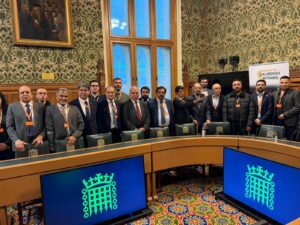

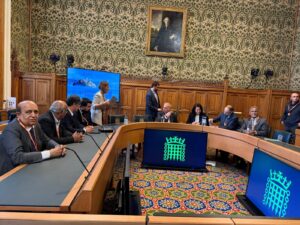
Part of Engineer Rahim Bandouie’s speech in the British Parliament/ Video and images
The Future of Iran:
The Situation and Perspective of Marginalised Nations within Iran
——————————————
Ladies and Gentlemen,
Honourable Members of Parliament, in Particular Mr Bambos,
Distinguished guests,
Thank to Cente for Kurdish Affairs, UK for giving us the opportunity to speak about the future of Iran and the aspirations of its marginalised nations
I speak not only as a political activist from the Balochistan People’s Party, but as a voice for communities whose suffering has too often remained invisible to the international community.
For decades, the Baluch people, alongside Kurds, Ahwazi Arabs, Turkmen, Azeri Turks, Lors, and others, have endured systemic discrimination under highly centralised governments in Iran —
both during the rule of the Pahlavi dynasty and under the current Islamic regime of Iran.
Our struggle is is against authoritarianism, exclusion, and the denial of human dignity.
⸻
The Reality in Baluchistan
Despite being rich in natural resources and strategically important location, Baluch regions remain among the poorest and least developed areas in Iran and with highest rate of executions.
* Chronic poverty and unemployment
* Lack of access to quality healthcare
* Educational deprivation
* Water insecurity and environmental neglect
* Political exclusion
* Religious discrimination against Sunni communities
* Heavy securitisation and militarisation
are what Generations of Baluch children have grown up without equal opportunities afforded to citizens in central provinces of Iran
Development has not been denied because of lack of potential.
It has been denied because power has been concentrated in Tehran under systems that do not recognise plurality and regional self-governance.
Both monarchy and the current Islamic system pursued the idea that a highly centralised state could impose unity through force and control.
But genuine unity cannot be built through fear.
History has shown that suppressing ethnic, linguistic, religious, and cultural diversity does not create stability. It creates resentment, distrust, and cycles of unrest.
Today, many communities inside Iran no longer believe that reform within a rigidly centralised structure can deliver justice.
This is why discussions about the future of Iran must include the voices of its nations and regions — not only political elites from the centre of Iran
⸻
Our Vision: A Democratic Federal Iran
We believe the future stability of Iran depends on a new social contract.
A democratic federal system offers the most peaceful, inclusive, and sustainable framework for the country’s future.
Federalism is not division.
Federalism is democratic power-sharing.
It means:
* Equal citizenship for all peoples
* Decentralisation of political power
* Regional self-governance within a united democratic Iran
* Protection of linguistic and cultural rights
* Fair distribution of national wealth
* Independent judiciary and rule of law
* Free elections and accountable institutions
Many successful democracies have adopted federal systems precisely because they recognised diversity as a strength rather than a threat.
A future Iran cannot survive through domination by one ideology, one ethnicity, or one centre of power.
It must become a partnership of its historical identified peoples.
⸻
When children lack schools, when mothers lack hospitals, when peaceful activists are imprisoned, when communities are collectively treated as security threats — this is not merely a regional issue. It is a question of universal human dignity.
We reject violence against civilians.
We reject sectarianism.
We reject hatred.
Our movement seeks democratic transformation through political participation, international solidarity, and recognition of fundamental rights.
⸻
The international community, including the United Kingdom, can play an important role.
We ask democratic governments to:
* Support human rights defenders and civil society
* Amplify the voices of marginalised communities
* Encourage democratic dialogue among Iran’s diverse nations
* Oppose repression and collective punishment
* Support peaceful democratic transition rather than renewed authoritarianism
The future of Iran should not simply be the replacement of one centralised authoritarian structure with another.
That would repeat the tragedies of the past.
⸻
Conclusion
The Baluch people with all other deprived nationalities do not ask for privilege.
We ask for equality.
We do not seek domination.
We seek dignity.
We believe a democratic and federal Iran can become a country where no child is disadvantaged because of ethnicity, language, religion, or geography.
The future of Iran will only be stable when all its peoples feel they belong equally within it.
Justice for all oppressed nationalities is not separate from democracy in Iran.
It is essential to it.
Therefor;
“A democratic Iran will only emerge when all its peoples are treated as equal partners in the future of the country.”
Thank you.
Balochistan People’s Party.